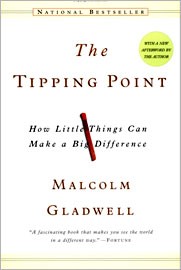
The Tipping Point
Malcolm Gladwell
As an Amazon Associate, we earn from qualifying purchases.
Audio Narration
AI-powered text-to-speech
Summary
At its heart, Malcolm Gladwell’s 'The Tipping Point' is a masterclass in social dynamics, exploring the mysterious ways in which ideas, products, and behaviors move from the fringes of society into the mainstream. Gladwell’s core thesis is that social change behaves exactly like a viral epidemic. Just as a single infected individual can trigger a global health crisis, a single person, a specific message tweak, or a minor environmental shift can trigger a massive social phenomenon. He identifies the 'Tipping Point' as that specific threshold or boiling point where a trend crosses a critical mass and begins to spread with unstoppable momentum. The book serves as a roadmap for understanding why some things 'go viral' while others languish in obscurity, suggesting that the world around us is far more sensitive to small changes than we might realize. Gladwell argues that by understanding the three governing rules of these epidemics—the Law of the Few, the Stickiness Factor, and the Power of Context—we can intentionally engineer positive social change or better navigate the chaotic landscape of modern trends.
Gladwell builds his argument through a series of vivid case studies and psychological theories, categorized into three distinct 'Rules of Epidemics.' First, the 'Law of the Few' posits that the success of any social epidemic is disproportionately dependent on the involvement of a tiny minority of exceptional people: Connectors, Mavens, and Salesmen. Connectors are the social glue who know everyone; Mavens are the information brokers who find the best deals and facts; Salesmen are the charismatic persuaders who convince us to believe. Second, Gladwell introduces the 'Stickiness Factor,' which addresses the internal quality of the message itself. He demonstrates through the evolution of children’s television (like Sesame Street) that for an idea to tip, it must be inherently memorable and actionable. Finally, the 'Power of Context' emphasizes that humans are exquisitely sensitive to their environment. Through the 'Broken Windows' theory, Gladwell illustrates how minor environmental cues—like graffiti or litter—can dictate large-scale human behavior, such as crime rates. He argues that our internal character is often secondary to the immediate external circumstances we find ourselves in.
Why does this matter in the real world? Gladwell’s work revolutionized how marketers, public health officials, and policymakers approach their work. Instead of trying to reach everyone at once with a massive, expensive campaign, 'The Tipping Point' suggests a surgical approach. By finding the right influencers (the Few), refining the message until it is impossible to ignore (Stickiness), and creating the right environment (Context), an individual can achieve exponential results with minimal resources. This has direct applications in everything from stopping the spread of disease to launching a startup. It challenges the traditional 'Big Bang' theory of change, whic...